


National Geographic 1988 December
Publisher: National Geographic
Format: Paperback
ISBN: none
National Geographic – December 1988 (Vol. 174, No. 6)
There are ordinary old magazines, and then there are magazines which appear to have been designed by someone who had just discovered holograms and was determined that civilisation should know about it. The December 1988 issue of National Geographic falls very firmly into the second category.
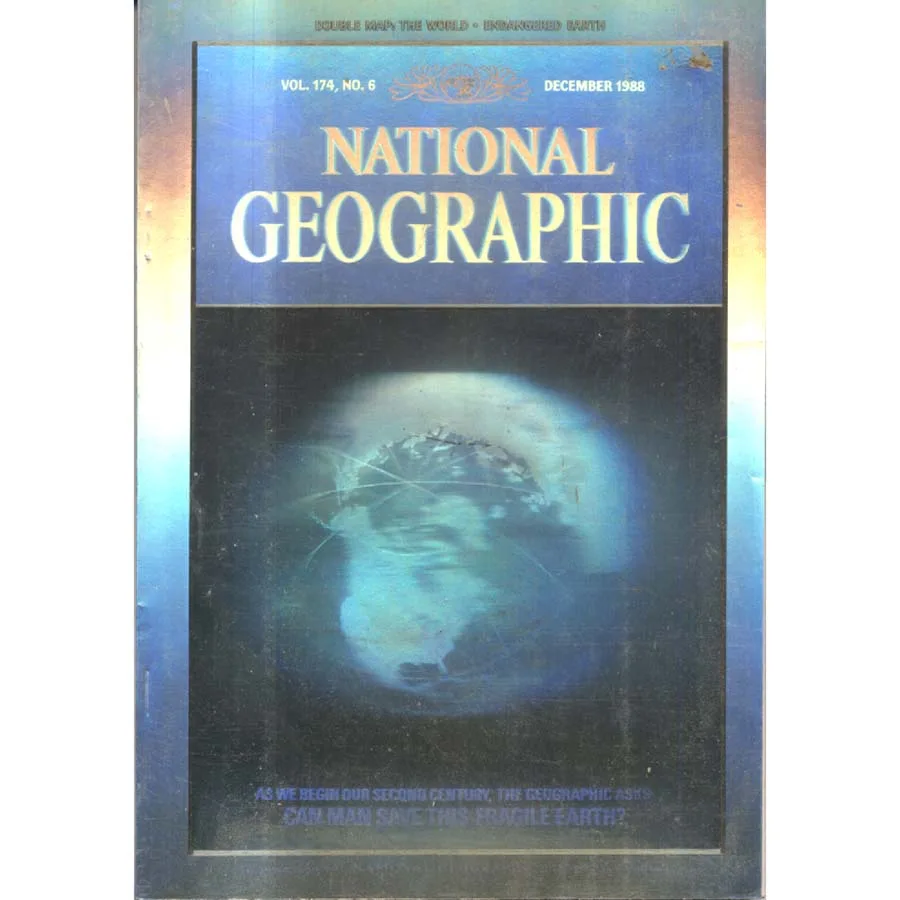
Published as National Geographic entered its second century, this is Vol. 174, No. 6, December 1988, and the cover announces the suitably enormous question: “Can Man Save This Fragile Earth?” Nothing modest for the centenary, then. Having spent its first hundred years photographing volcanoes, deserts, tribes, oceans, cities, archaeological ruins and people standing beside unusually large vegetables, the Society apparently decided it was time to assess whether humanity had made a terrible mess of the whole arrangement.
What makes this particular issue immediately distinctive is its remarkable holographic front and back cover. Tilt it under the light and the image shifts and glimmers in the gloriously futuristic manner that seemed, in 1988, to suggest that by about 2005 we would all be travelling to work by monorail. It is an impressive piece of period publishing design and considerably more exciting than the usual cardboard wrapper. Even now it has that wonderfully late-1980s combination of scientific seriousness and “LOOK! THE PICTURE MOVES!”
Across the top appears the theme “Double Map the World – Endangered Earth”, while the cover itself presents the planet floating ominously in darkness. The message is subtle in roughly the same way as an approaching iceberg: Earth is precious, Earth is vulnerable, and perhaps everyone should stop behaving as though another one can be ordered from the warehouse.
The issue belongs to an especially interesting moment in environmental history. By the late 1980s, concern about endangered species, disappearing habitats, pollution, population pressures and humanity’s effect upon the planet was moving decisively into mainstream public consciousness. National Geographic, having spent a century showing its readers what the world looked like, was particularly well placed to point out that it might be advisable not to ruin it.
There is also something rather poignant about reading environmental warnings from 1988. The magazine asks whether mankind can save the fragile Earth, and nearly four decades later the question remains very much open, suggesting that humanity has perhaps been giving the matter the sort of attention normally reserved for replacing a dripping tap.
As ever with National Geographic, the appeal is not merely the articles but the whole physical production: substantial photography, maps, diagrams, advertisements, typography and that unmistakable sense that somebody somewhere has gone to extraordinary trouble to explain a distant place to a reader sitting comfortably at home. Old issues have also become accidental social-history documents, preserving everything from contemporary technology and travel to advertisements for products which were apparently considered the absolute pinnacle of modern civilisation in 1988.
For collectors, however, the holographic treatment gives this issue particular visual appeal. It is the sort of cover that immediately distinguishes itself in a pile of magazines and invites repeated tilting backwards and forwards to see exactly what happens—an activity which remains strangely compelling despite the existence of smartphones, virtual reality and satellites capable of photographing your garden furniture.
This copy is in Good condition, showing the normal signs of age and previous handling expected of a magazine dating from 1988. The important holographic front and back remain the defining feature, giving it considerably more shelf presence than your average periodical and making it a particularly nice example for collectors of National Geographic, unusual magazine covers, environmental history or spectacular late-twentieth-century printing gimmicks that were actually rather good.
An attractive and distinctive centenary-era issue from one of the world’s best-known magazines: part environmental warning, part geographical celebration and part demonstration that, in 1988, attaching a hologram to something could instantly make the future seem reassuringly close.
Sold by Crappy Old Books, where the Earth remains fragile, the books remain second-hand, and the hologram still gets tilted several times before anybody manages to put it on the shelf.
Keep browsing: See more National Geographic books Other books by National Geographic
